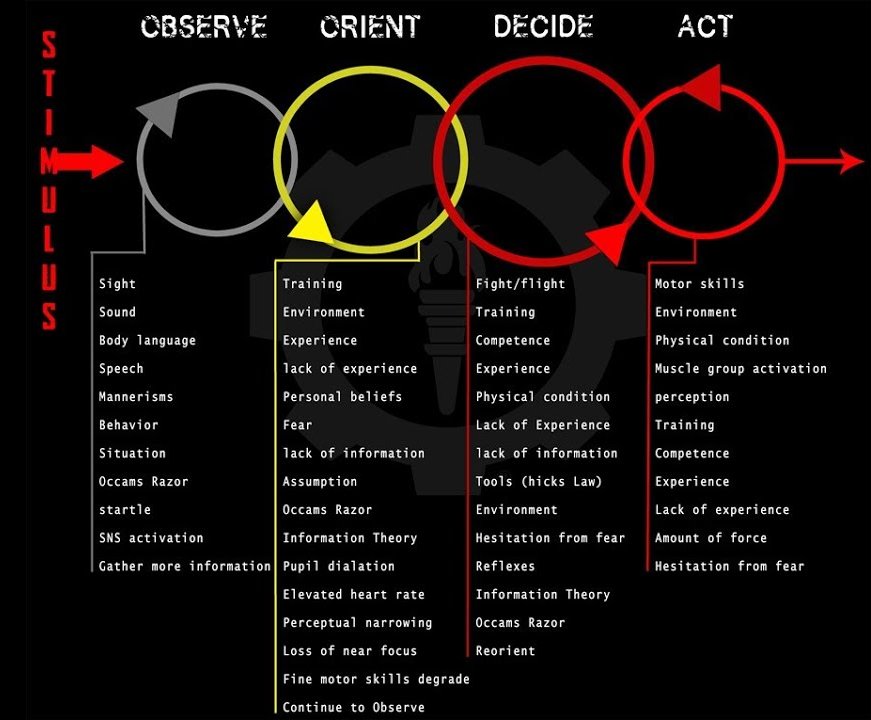
OODA loop - Observe-Orient-Decide-Act
This is a model of how decision making happens, in general, and when we face a violent or threatening action.
Observe: What is happening? You have to see (feel or hear) what's happening to be able to do something about it.
Orient: Interpreting the information your senses are giving you. Going from seeing a fist becoming larger (i.e. closer) in your field of vision, to "He's punching me!".
Decide: Only once you've made sense of what you are seeing can you decide what to do about it.
Act: Once the decision is made, the brain sends signals to the body to start moving. You don't actually start responding until after the previous three steps are done.
This is a continuous cycle. Every new thing that happens is something to observe, etc. If too much new information keeps coming in, or we can't make sense of what we are seeing, we can get stuck in Observe-Orient and never get to Act. Training helps us move through the cycle faster.
This is a model of how we function most of the time, but the principle of operant conditioning suggests a way to bypass this, making a shortcut from Observe to Act. If you touch a burning hot pan, there's a direct response in your hand pulling back. It doesn't need to stop by the brain to make sense or decide about it. This is something we can utilize in training for a conditioned 'counter ambush' response. If stimulus X happens - run response Y.
Sources:
- Rory Miller: Facing Violence-Preparing for the Unexpected
- Chiron Cohort Masterclasses - Awareness